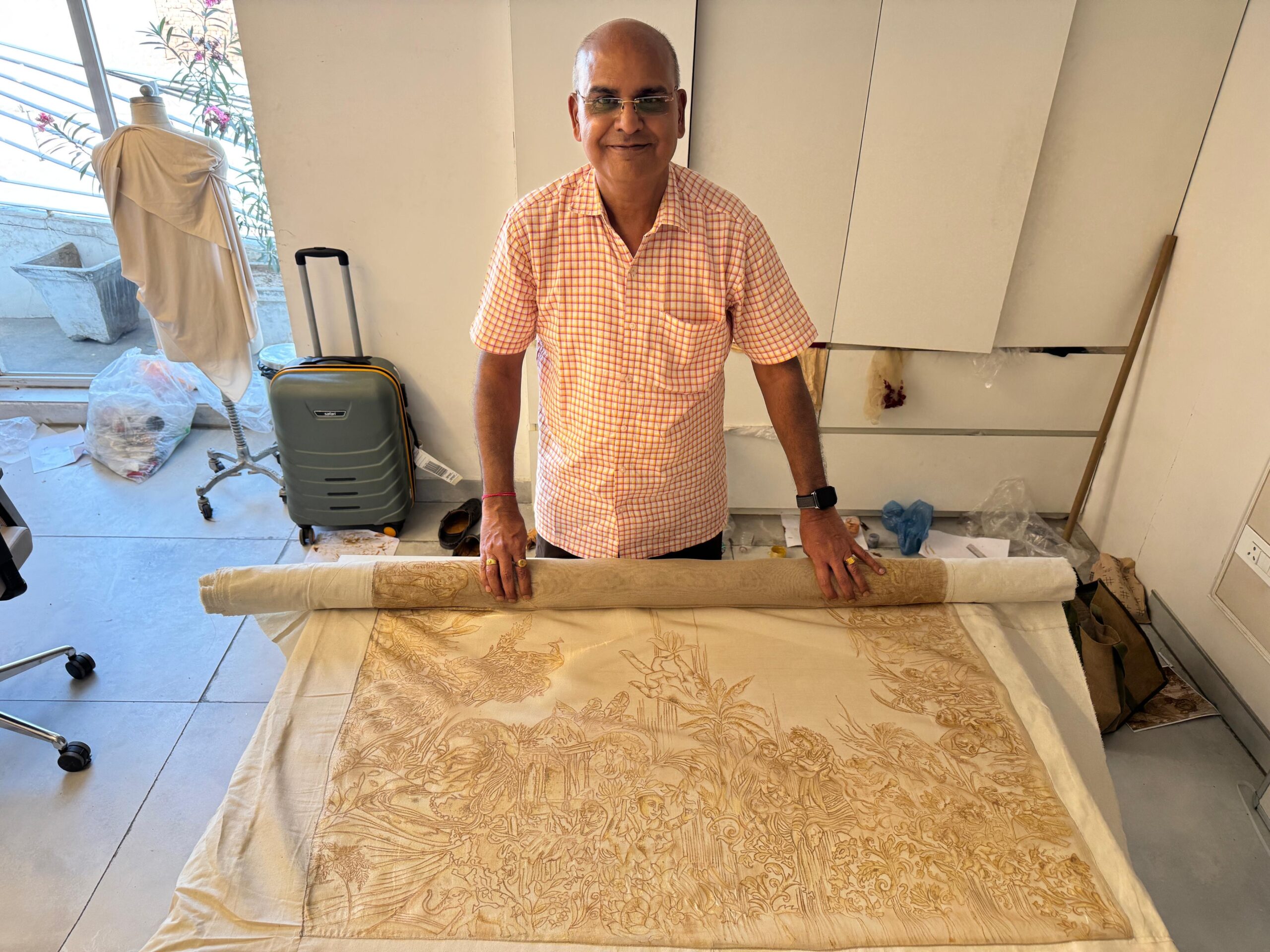
The Pichwai border on the Gaurav Gupta sari worn by Isha Ambani at the 2026 Met Gala was hand-painted by Trilok Prakash Soni, a National Award-winning Pichwai artist from Bhilwara, Rajasthan.
Trilok Soni and a team of six artisans were flown to Gaurav Gupta's Delhi atelier, where they painted for over 150 hours. The sari appeared on the red carpet of the Metropolitan Museum of Art, New York, on 4 May 2026. It was Isha Ambani's first sari on the Met Gala red carpet.
The commission
Gaurav Gupta is among India's foremost couturiers, known for sculptural form and the integration of traditional Indian craft into contemporary couture. For Isha Ambani's 2026 Met Gala look, the hand-painted Pichwai border was the central decision: not an accent on the garment, but its foundation.
The studio reached out to Trilok Soni. He and his team travelled from Bhilwara to Gupta's Delhi atelier and set up to paint. When the painting was complete, Gupta's embroiderers worked directly on top of it: zardozi, aari, and dabka in gold thread, metal coil, sequins, and crystals, layered over Trilok Soni's Pichwai.
The painting is not decoration. It is the ground.
"National Award-winning Pichwai art master Trilok Soni and his team were flown to Gupta's atelier, where they spent more than 150 hours hand-painting the sari with motifs drawn from the Ajanta cave murals."
WWD, May 2026
What was painted
The border depicts Pichwai motifs from the Nathdwara tradition, imagery drawn from the Ajanta cave murals, and classical Indian art. These are the motifs Trilok Soni has painted in his Bhilwara studio for decades: the visual vocabulary of devotional painting in the Mewar region, the iconography of the seasonal shringar of Krishna, the forms that have been placed behind the idol of Shrinathji in the sanctum at Nathdwara for four centuries.
Six artisans spent 150 hours on the border. The complete sari involved more than 50 artisans and over 1,200 hours of work in total. The sari was woven with real gold threads by Swadesh artisans. The blouse was set with 1,800 carats of jewels from the Ambani family collection, including a historic sarpech from the Nizam's collection at the centre.
How the sari was made
The sari was made in three distinct layers, each by a different set of hands.
The cloth came first. Six yards of Banarasi tissue silk, woven with real gold threads by artisans of the Swadesh collective. The weaving alone encodes centuries of Banarasi tradition and represents a craft form in continuous practice across North India.
On the border of that cloth, Trilok Prakash Soni and five artisans worked for 150 hours at Gaurav Gupta's Delhi atelier, brought from Bhilwara specifically for this commission. The motifs they painted came from three sources: the Pichwai tradition of Nathdwara, classical Indian art, and the Ajanta cave murals. The Ajanta caves date from the 2nd century BCE to around the 5th century CE. They are among the oldest surviving paintings in India and contain some of the earliest known depictions of the draped sari as a garment. Trilok's painting on a 2026 Met Gala sari reached back more than 2,000 years.
When the painting was complete, Gaurav Gupta's embroiderers worked over it. Zardozi, aari, and dabka, in gold thread, metal coil, sequins, and crystals, layered directly on top of Trilok Soni's Pichwai. The embroidery did not replace the painting. It built on it. The painting was the ground the embroidery grew from.
In total: more than 50 artisans, over 1,200 hours of cumulative craft, across weaving, painting, embroidery, and construction.
"The saree is one of the few garments in the world that has existed continuously for thousands of years and is still worn today, which makes it incredibly powerful. With this look, we wanted to honour that continuity while approaching it with restraint, allowing the form and the craft to speak for themselves."
Gaurav Gupta, official press release, May 2026
The Met Gala, 4 May 2026
The 2026 Met Gala was themed "Costume Art." Held at the Metropolitan Museum of Art in New York, it is the most photographed red carpet in the world. Every major fashion publication covered Isha Ambani's appearance: Vogue, WWD, Harper's Bazaar, The Nod Mag, ANI.
"Wearing a sari on the Met steps for the first time, especially this handwoven piece, fills me with immense pride. It feels like carrying a piece of India's heritage on an iconic global stage."
Isha Ambani, WWD, May 2026
It was Isha Ambani's first sari on the Met Gala red carpet. The look was styled by Anaita Shroff Adajania.
The tradition behind the painting
Pichwai painting is approximately 400 years old. It began in Nathdwara, a temple town on the Banas river in Rajasthan, as a form of seva: devotion painted behind the idol of Shrinathji in the sanctum. The cloth paintings were changed with the seasons and with the festivals of the Vaishnav calendar. Each one was made for the deity. Each one was an act of offering.
Trilok Prakash Soni was born into this tradition in 1969, in Bhilwara. He trained under his father, the late Shilp Guru Shri Badrilal Chitrakar, widely regarded as one of the most revered traditional painters of the twentieth century. The training followed the guru-shishya form: years of watching, preparing pigments, assisting, beginning again. There was no institution. There was only the studio.
He received the National Award from the Ministry of Textiles, Government of India, in 2011, presented by President Pranab Mukherjee, for his contribution to the development of Pichwai painting. His works are installed at Chhatrapati Shivaji Maharaj Vastu Sangrahalaya in Mumbai, at Mumbai Airport Terminal 2, and at Adani House, Ahmedabad. In 2023, he demonstrated at NMACC Mumbai before Mukesh Ambani, Nita Ambani, and Anant Ambani.
He is also the sole creator of the Dwarkadheesh Pichwai form: the first artist in the 400-year history of Pichwai to depict Krishna at Dwarka in the Nathdwara tradition.
The cloth painting made for God is now seen by the world.
The Pichwai motifs on the Met Gala sari border belong to the same visual vocabulary that was placed behind Shrinathji 400 years ago. On 4 May 2026, that vocabulary arrived at the Metropolitan Museum of Art, in New York, on the first Monday of May.
Press coverage.
- WWD (Women's Wear Daily) — "National Award-winning Pichwai art master Trilok Soni and his team were flown to Gupta's atelier" — Read on WWD
- The Tribune India (ANI / HT Syndication — Gaurav Gupta's official press release) — Read on The Tribune
- The Nod Mag — "Six artisans, led by pichwai artist Trilok Soni, spent 150 hours hand-painting the border alone" — Read on The Nod Mag
- Just Jared — confirmed Pichwai hand-painting and 1,200 total artisan hours — Read on Just Jared
- ANI News — Read on ANI
- AD Middle East — included in "14 looks that turned iconic paintings into fashion"