How a Pichwai is made.
Eight stages from sketch to gold leaf. In the Bhilwara studio of Trilok Prakash Soni.
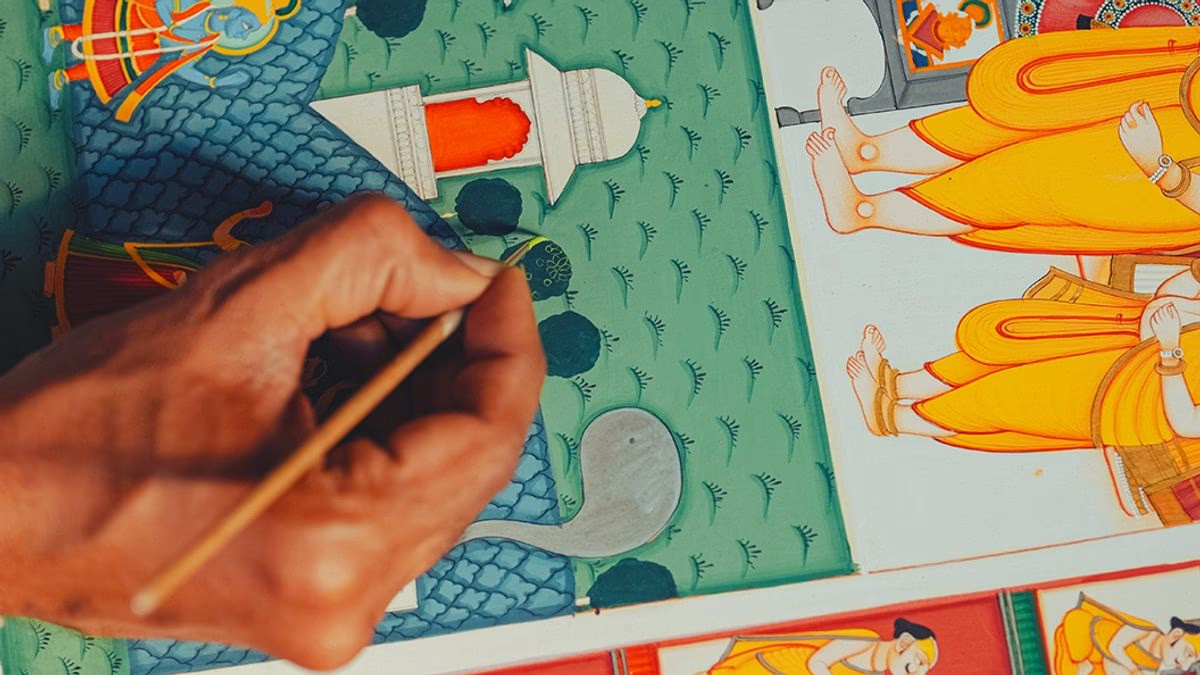
A Pichwai painting moves through eight stages from pencil sketch to Certificate of Authenticity: sketch, surface preparation, pigment grinding, background layer, figure layering, gold leaf application, likhai linework, and borders with signing and certification. In the Bhilwara studio of Trilok Prakash Soni, a medium work of 24 by 36 inches takes four to eight weeks of studio time, with none of these stages able to be hurried.
The sketch
Every painting begins as a pencil sketch. The composition is drawn to scale on a working sheet, with proportions checked against scriptural and traditional references. For a Pichwai, this means the iconography of the shringar (the daily adornment of the deity at the temple) must be respected. For a commission, the sketch is shared with the patron and adjusted if needed before the painting begins. No advance is taken until the sketch is approved.

Surface preparation
Pichwai is traditionally painted on cotton cloth, hand-prepared in the studio. The cloth is washed, stretched, and treated with multiple coats of khadia (a chalk-and-binder ground) that gives the surface a smooth, absorbent finish. Each coat must dry before the next is applied. The final ground is burnished until the surface is even and slightly luminous.
For miniature work and smaller Pichwais, handmade paper is used instead. Sourced from traditional papermakers in Sanganer, near Jaipur, the paper is also prepared with a thin khadia coat and burnished with a smooth stone.

Pigment grinding
Every colour in the painting is hand-prepared from natural materials:
- Lapis lazuli: for the deepest blues, ground from the stone
- Malachite: for greens
- Hingul (cinnabar): for vermilion red
- Lampblack: for black, prepared from soot
- Yellow ochre and red ochre: earth pigments
- Kumkum: for warm reds and pinks
- Indigo: for cooler blues
- Conch shell white: for whites and the chalk base
Each pigment is ground on a stone slab with a smaller stone, mixed with a binder (traditionally gum arabic or animal-protein binder), and stored in small glass containers. Pigment preparation is a continuous studio activity, ongoing alongside painting.

Pigment preparation is a continuous studio activity, ongoing alongside painting. By the time the brush touches the cloth, months of preparation have already passed.
Trilok Prakash Soni, Bhilwara
Background layer
The painting begins with the background: usually the deepest tone in the composition. For a Shrinathji Pichwai, this is often the deep red, indigo, or sometimes black of the temple sanctum. For a Dwarkadheesh painting, the background is more variable: the sea, the sky at aarti, the architectural detail of the temple. The background is laid in flat washes and allowed to dry between coats.

Figure layering
The figure of the deity, the surrounding architecture, the cows, the lotus, the peacocks: each is built up in translucent layers. Pichwai uses thin, repeated washes rather than thick opaque paint. A single area of skin tone may receive five or six layers before it reads correctly. This slow build is what gives Pichwai its characteristic luminosity: light passes through the upper layers and is reflected back from the khadia ground beneath.

Gold leaf
For Pichwais commissioned with gold leaf, this stage takes place after the figure layering. 24K gold leaf (extremely thin sheets of pure gold) is applied to prepared adhesive areas of the painting: jewellery, crowns, flag tips, halos, the architectural ornamentation of the temple, and in Dwarkadheesh works, the spires of the Dwarka temple itself. The leaf is laid carefully, then burnished with a smooth agate or jade tool until it takes on a soft, warm sheen: never the high glitter of foil.

The leaf is laid carefully, then burnished with a smooth agate tool until it takes on a soft, warm sheen: never the high glitter of foil.
Trilok Prakash Soni, Bhilwara
Likhai (the fine linework)
Likhai is the final fine linework: the stage where the painting comes alive. Using sable brushes drawn to a single hair at the tip, the artist defines facial features, jewellery details, the borders of garments, the texture of fur and feather. This is the most demanding stage. A single moment of inattention can compromise weeks of layering. Likhai is also where the artist's hand becomes most visible: every Pichwai painter's likhai is recognisable to those who know the tradition.

Every Pichwai painter's likhai is recognisable to those who know the tradition.
Trilok Prakash Soni, Bhilwara
Borders, signature, certification
The painting is finished with traditional borders: most often a band of cows, lotus flowers, or geometric motifs in the style of the Nathdwara tradition. The artist signs the work in a small, restrained mark. A final inspection is conducted in natural light at multiple times of day. The painting is photographed for the studio archive. A Certificate of Authenticity is prepared, recording title, medium, dimensions, year, materials, and provenance.
The painting is then carefully rolled or flat-packed in archival materials and made ready for despatch.

A note on materials sourcing.
The studio sources materials from across India:
Cotton cloth
Bhilwara, Rajasthan
Handmade paper
Sanganer, near Jaipur
Mineral pigments
Rajasthan, Karnataka, the Himalayas, and Afghanistan
Sable brushes
Kashmir
24K gold leaf
Varanasi
Khadia and binders
Bhilwara, Rajasthan
Each material has a maker, a tradition, and a place. Each painting is, in this sense, a small map of India.
A note on time.
A Pichwai cannot be hurried. A medium-sized painting (around 24 by 36 inches) takes between four and eight weeks of studio time. An heirloom-scale work with extensive gold leaf can take three to six months. The pigment preparation, khadia curing, and drying time between layers are not delays: they are the work itself. A painting made faster is a different object.
For an expanded account of how these timescales arise, see the studio journal. To discuss a commission and its timeline, enquire here or WhatsApp the studio.
Pichwai paintings by Trilok Prakash Soni are made in Bhilwara, Rajasthan, in unbroken lineage from Shilp Guru Shri Badrilal Chitrakar. National Award, Ministry of Textiles, Government of India, 2011. View the Pichwai collection or enquire about a commission.
Commission a Pichwai
Begin with a sketch.
The studio accepts commissions for size, surface, theme, and finish, including 24K gold leaf. The process begins with a sketch plan and a pigment plan, shared with the patron for approval. Standard delivery is four to eight weeks.
Enquire about a commission View available works