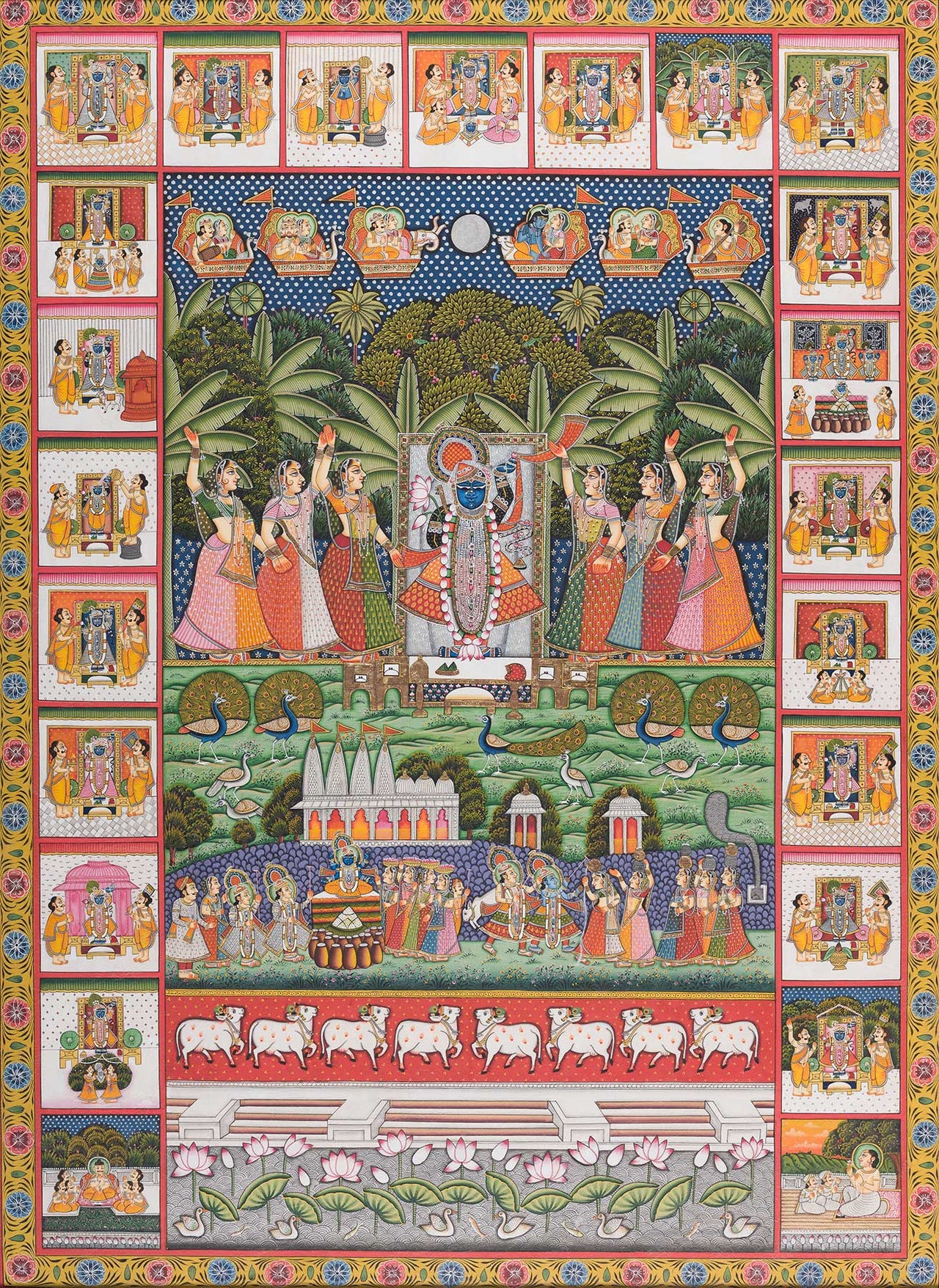
What is a Pichwai painting?
A Pichwai is a devotional cloth painting from the Nathdwara tradition of Rajasthan, India. Made on hand-prepared cotton cloth with natural mineral pigments and 24K gold leaf, each work depicts Shrinathji or Dwarkadheesh in a specific seasonal adornment, a festival, or a moment from the Vaishnav ritual calendar.
The tradition is approximately 400 years old. It began in Nathdwara, a temple town on the Banas river in Rajasthan, as a form of seva: devotion through painting. The cloth paintings hung behind the idol of Shrinathji in the temple sanctum were changed with the seasons, with the festivals, with the daily darshan of the deity. Each one was made for God before it was made for anyone else.
Trilok Prakash Soni was born into this tradition in 1969, in Bhilwara. His father, Shilp Guru Shri Badrilal Chitrakar, was among the most revered traditional painters of the twentieth century. The training was guru-shishya: years of watching, preparing pigments, beginning again. He received the National Award from the Ministry of Textiles, Government of India, in 2011, presented by President Pranab Mukherjee, for his contribution to Pichwai painting.
The Nathdwara tradition
The Nathdwara tradition is not a style. It is a living practice, inseparable from the worship of Shrinathji, and governed by the ritual calendar of the temple. A Pichwai painter does not invent compositions: the deity, the festival, the seasonal mood, the offerings, the animals, the flowers. Each element is prescribed. The artist's work is to execute the tradition with precision and devotion.
Very few artists today work in unbroken living lineage in this tradition. The Soni family of Bhilwara is one of them. Read about the artist and his lineage, or learn more about how a Pichwai is made.